


On October 16, 2014 the appellate court of Budapest made a legally binding decision regarding the demolition of self-built shacks by the municipality of the 14th district of Budapest. The court ruled that the municipality acted illegally when it destroyed the shacks and other possessions of six homeless people on October 18, 2011. Prior to the demolition, the authorities had not initiated any official procedures against the shack-dwellers. Many inhabitants were not at home when the bulldozers arrived and were thus not able to save any of their belongings. Those who were present were forced to witness the destruction of their homes and were offered no appropriate alternative accommodation.
 The Centralized Electronic Registration of Recipients of Social Services (KENYSZI) was introduced in 2012 as a way to keep track of the users of all social services in Hungary including support for homeless people, the elderly, disabled people and children. The development of the system was co-financed by funds from the European Social Fund under TÁMOP 5.4.2-08 and TÁMOP 5.4.2-12. Over time, it has become clear that for homeless people, the introduction of KENYSZI has made life – even survival – more difficult. The City is for All (A Város Mindenkié) is fighting for a social services system that is transparent, humane, respects privacy and ensures that no eligible citizen is denied a service because of bureaucratic reasons or exposed to discrimination. In its present form, KENYSZI does not meet these requirements.
 The housing crisis in Hungary cannot be understood independently from the European economic space. Housing difficulties are not independent from European policies supporting the free market and the liberalization of the real estate and banking sector, or restraining state supported social housing construction. The Europe-wide deepening housing crisis – from the Spanish mortgage crisis through the difficulties of the French social housing system to the undignified and for poor people unaffordable housing stock in Eastern European countries – puts a growing pressure on the European Union to consider housing issues among its common policies.
 The representation of homeless people in the Hungarian media is often based on harmful stereotypes, which not only stigmatise homeless people, but also destroy the common sense of solidarity in our society. In the following article, we will present the main problems that homeless members of The City is for All, a homeless-led advocacy group in Budapest, and their allies have identified. In the second part of the article, we will offer suggestions for potential solutions as well. This text is based on the English translation of a leaflet that our group has distributed to thousands of press workers and media organisations over the past few years.
 On February 24, 2014 the Court of Budapest ruled that the municipality of the 14th district of Budapest acted illegally when it destroyed the shacks and other possessions of homeless people on October 18, 2011 (see the photos of the destruction
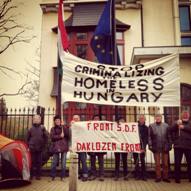 In response to the call for action by The City is For All, local organizations and individuals in 14 cities of three continents – from New York to Bangkok and Dublin to Istanbul – staged protests against the criminalization of homelessness in Hungary in front of Hungarian embassies and consulates.